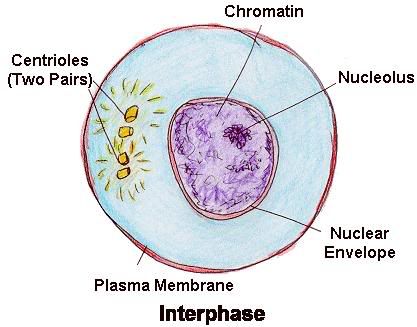
Mitosis is when a cell divides itself in half to make two identical copies.Before mitosis, the cell creates an identical set of genetic information – this is called DNA replication or 'Interphase'. The duplicated genetic information then winds up into a visible object called a chromosome. A chromosome is made up of two chromatids joined at the centromere.
There are six phases of mitosis. Each phase is used to describe what kind of change the cell is going through. The phases are interphase, prophase, metaphase, anaphase, telophase, and cytokinesis. Some may consider pro-metaphase as part of the phases but most believe it is part of metaphase and some of prophase. Each phase is important to mitosis.
Interphase
The chromosomes cannot be seen but they duplicate the DNA and double in mass when it starts to copy its own DNA.
Prophase
During prophase, chromosomes in the nucleus condense, pairs of centrioles move to opposite sides of the nucleus, spindle fibers form a bridge between the ends of the cell, the nuclear envelope breaks down and the nucleus begins to disappear.

Metaphase
During metaphase, the chromosomes are pulled by microtubules called spindle fibers into place. The chromosomes line up on the cell's equator, or center line, and are prepared for division.

Anaphase
During anaphase the chromosomes move from the cell's equator (metaphase plate) to their respective poles of the cell. The cell begins to stretch out as the opposite ends are pushed apart.
Telophase
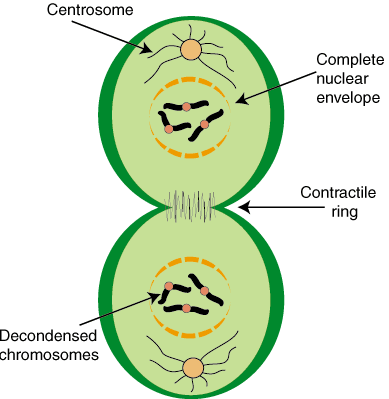
Telophase is the final stage in mitosis, as the cell itself is ready to divide. One complete set of chromosomes is now at each pole of the cell. The spindle fibers begin to disappear, and a nuclear membrane forms around each set of chromosomes. Also a nucleolus appears within each new nucleus and single stranded chromosomes uncoil into invisible strands of chromatin.
Cytokinesis
Main page: Cytokinesis
Cytokinesis, even though it is a very important to cell division, is not considered a stage of mitosis. During cytokinesis, the cell physically splits. This occurs just after anaphase and during telophase. The cleavage furrow, which is the pinch caused by the ring of proteins, pinches off completely, closing off the cell. The cell now has reproduced itself successfully. After cytokinesis, the cell goes back into interphase, where the cycle is repeated. If cytokinesis were to occur to a cell that had not gone through mitosis, then the daughter cells would be different or not function properly. One would still have the nucleus and the other would lack a nucleus. Cytokinesis is different in both animals and plant cells. In plant cells, instead of splitting into two halves, it forms a cell plate.